The money lessons school never got to
Vasmio is the UK startup behind Moneywell Town, a free browser game that teaches 15 to 18 year olds how money actually works: interest, saving, credit, scams, tax and mortgages. Anyone 15 or over can play. Skipper, its AI helper, runs on Anthropic’s Claude.

The problem
Teenagers want to learn about money. School is not where it happens.
The bills arrive at eighteen all at once: a first payslip, a tenancy deposit, a credit file. Most teenagers say they want to learn about money before then, and few say school is where they learn it. Moneywell Town is built for those years.
- 80%of UK 15 to 18 year olds want to learn more about money.
- 9%say school is where they get most of their money knowledge. 61% say their parents.
- 19%answer all three interest, inflation and risk questions correctly.
- 34%picked financial education apps with competitions or games when asked what would help, joint highest of nine approaches tested.
Source: LFBF Young Persons' Money Index 2025/26 (opens in a new tab), published 27 November 2025.
Moneywell Town
Learn it in town. Get quizzed on it in the outskirts.
A retro handheld-style game that runs in any browser. Every lesson is a few illustrated pages, every quiz question carries its explanation, and every answer is scheduled to come back.
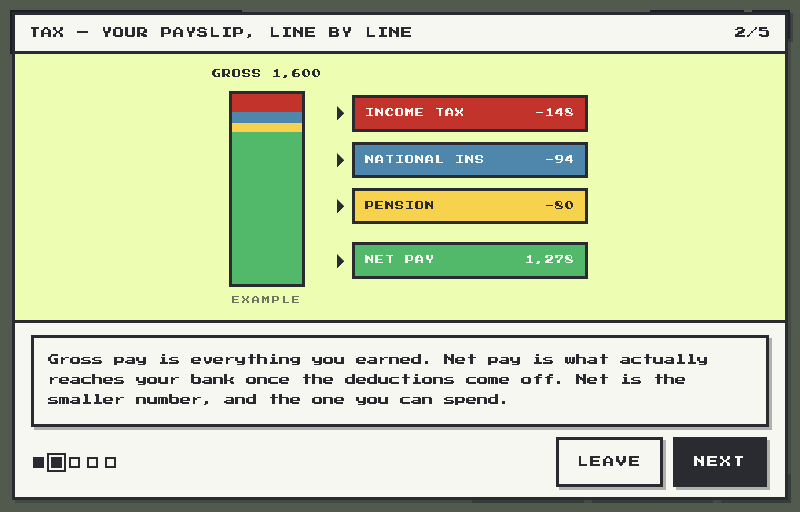
Learn it from someone in town
Northwell Bank, Penny & Clarke Accountants and Keystone Mortgages teach six topics in short illustrated lessons. All 144 pages are drawn, each built around a diagram.
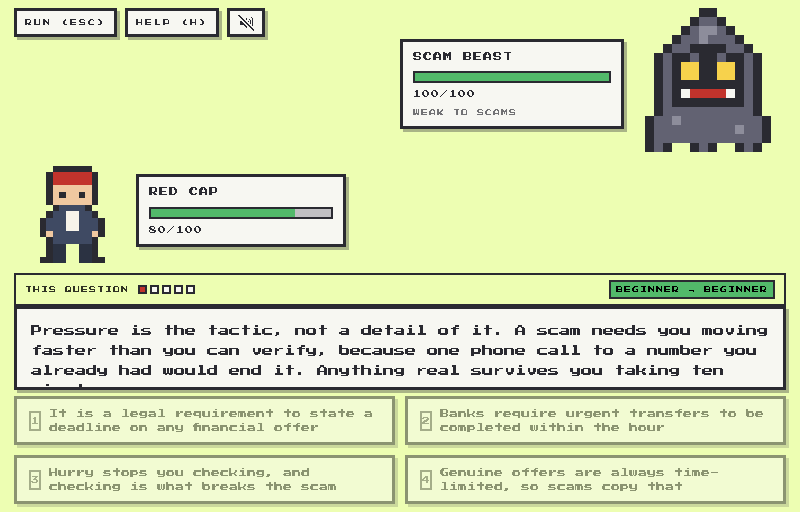
Battle what you learned
In the outskirts, creatures quiz you. The four answers are your four moves. Right or wrong, the explanation appears, so every fight teaches something.
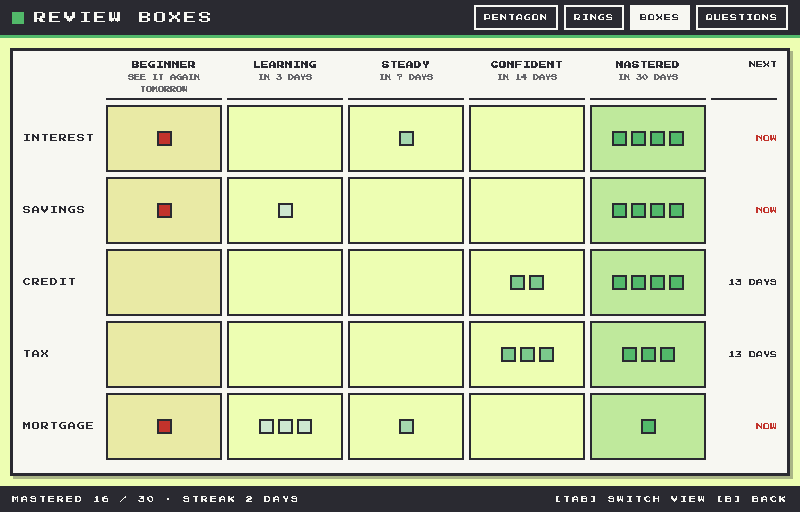
See it again before it fades
Every answer moves through five review boxes on 1, 3, 7, 14 and 30 day intervals. A wrong answer drops one box, never back to the start.
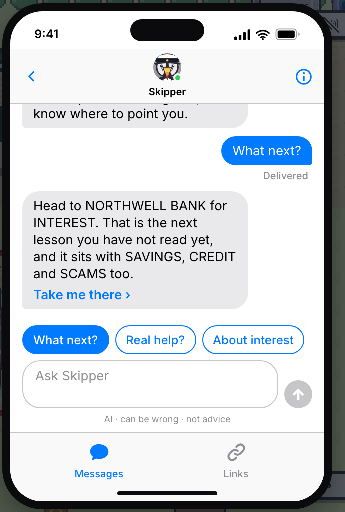
Ask Skipper when stuck
Skipper is an AI helper that runs on Anthropic’s Claude, built from every lesson page. He points to the building that teaches the answer, never names a product, and screens out card, bank and other personal details before a message is sent.
Why the schedule: spaced retrieval beats cramming, with a pooled effect of g = 0.74 across 29 studies. Latimier, Peyre and Ramus, Educational Psychology Review 33, 2020 (opens in a new tab).
Six topics, eighteen lessons
Interest
Northwell Bank
- Interest basics
- Compound interest
- The cost of borrowing
Saving
Northwell Bank
- The emergency fund
- Saving habits & pots
- Accounts, rates & risk
Credit
Northwell Bank
- Your credit file
- Borrowing & how it reads
- When debt goes wrong
Scams
Northwell Bank
- How a scam works
- Spotting the fake
- Mules, money back & reporting
Tax
Penny & Clarke Accountants
- Your payslip, line by line
- Allowances, bands & codes
- Self Assessment, VAT & paperwork
Mortgages
Keystone Mortgages
- Deposits & LTV
- Rate types
- Terms, repayment & joint
- 144
- illustrated lesson pages, every one drawn
- 148
- quiz questions, each with a written explanation
- 0
- accounts, emails or cards needed to play
Safety
Built on Claude, built for young players.
Moneywell Town is built for 15 to 18 year olds, and anyone 15 or over can play. Every player gets the same protections, whatever age they give.
- Claude, behind our own relay. Skipper’s questions go through a relay we run to Anthropic’s Claude API. The game never holds a key, and the phone still answers offline with scripted replies.
- Personal details held back. Card and bank numbers, emails, phone numbers, schools and names are screened on the device and again on the relay. A Claude pass swaps names and places for tags before the answering model sees them.
- Crisis words never reach a model. They get a fixed reply pointing to Childline, Samaritans and StepChange.
- Rules written for young players. Skipper never recommends a product or tells a player what to do with their money, refuses sexual or romantic content, and says on screen that it is an AI and can be wrong.
- Nothing kept by us. No accounts, no player database, and we never log what a player types. Anthropic keeps Skipper messages for 30 days, as the privacy page explains. Analytics stay off until a player opts in.
- Assessed against the Children’s Code. Our data protection impact assessment was approved in October 2026, with the game reviewed against all 15 standards of the ICO’s Children’s Code.
The detail is in the game’s privacy & safety page (opens in a new tab) and terms of use (opens in a new tab).
For funders
Built to be funded by banks. Free to every player.
Under the FCA's Consumer Duty (opens in a new tab), firms have to show that customers understand the products they hold. Funding impartial education for young people supports that without being marketing.
We are talking to our first funders now.
What a funder gets
- A building in town with its name on the door, teaching one of the six topics.
- Impartial education to point to when showing it helps customers understand money, as Consumer Duty asks.
- An example to walk into. The WORKINFINTECH building in the game shows what one looks like. It is an example from the hackathon, not a funder: Work in Fintech does not fund the game.
What a funder never gets
- Player data. Progress lives in the player’s browser. There is no account and no database.
- Product placement. A funded building teaches and sells nothing.
- A say in the answers. No product is recommended anywhere in the game.
The rules the game is built under
- Inform, educate, simulate and signpost.
- Never recommend a product.
- Never tell someone what to do with their own money.
- Prefer concepts to figures, because rates and thresholds date within a year.
Company
From Team 17 to Vasmio
Work in Fintech chose 120 young people from 1,300 applicants for the AI hackathon at the Work in Fintech AI Summit 2026 on 28 August 2026, and split them into 20 teams. Team 17 built Moneywell Town and took first place out of 20 (opens in a new tab). Four of the team's six members then founded Vasmio to keep building it.
- Vu Dao (opens in a new tab)Chief executive, co-founder
- Akshay Reddy Gujjula (opens in a new tab)Chief technology officer, co-founder
- May Yu (opens in a new tab)Chief marketing officer, co-founder
- Sean Muriithi (opens in a new tab)Founding engineer
Contact
Talk to us
Write to the founders directly. Pick what it is about and your email opens with the subject filled in.